
Cohl
Miller

Instructional Design Projects
This collection showcases a range of projects that exhibit my skills and expertise in designing effective learning experiences. Throughout the portfolio, you will discover how I incorporate innovative digital tools and techniques into my instructional designs, creating engaging and interactive learning experiences that promote creativity, critical thinking, and digital literacy.

30.60.90
30.60.90 is an innovative onboarding program for Brigade, a marketing and branding firm. It is designed to not only immerse new hires in the company's vibrant culture and design ethos but also equip them with essential information and training for seamless integration. Leveraging interactive virtual modules—such as an interactive map styled as a scavenger hunt —the initiative balances engaging content with practical learning, ensuring employees gain a thorough understanding of their roles and the company's operations while fostering a sense of community and belonging, something crucial in remote work environments.


Analysis
Problem Analysis and Solution Recommendation: This project grew from analyzing the onboarding process and recognizing the need for a comprehensive onboarding process. Given the remote nature of many workers and the company's strong focus on culture, virtual modules with a heavy emphasis on culture building were recommended.
Data Collection and Analysis: Data was gathered on company culture and branding along with new employee integration challenges and preferences to drive the conception and construction of the modules.
Communication
Effective Communication in Various Formats: The clear, concise, and visually appealing design of the onboarding documents and modules reflect proficiency in producing grammatically correct messages and visuals adhering to message design principles
Presentations and Meetings: The interactive onboarding process was presented to stakeholders including the head of the Human Resource Department through the facilitation of an engaging presentation and meetings to achieve set agendas and goals.
Visuals Adhere to Principles of Message Design: Visual elements used in the onboarding process, like infographics and interactive interfaces, were designed to be aesthetically pleasing and informative.


Design
Learning Theory and Design Integration: This project grew from analyzing the onboarding process and recognizing the need for a comprehensive onboarding process. Given the remote nature of many workers and the company's strong focus on culture, virtual modules with a heavy emphasis on culture building were recommended. By applying learning theory and systems thinking, the project strategically mapped out an onboarding process that adapts to the evolving needs of new hires over their first 90 days, ensuring a solid foundation and gradual immersion into the company culture and responsibilities.
Branding and Style: Brigade leans heavily on presenting clear and modern designs that align to their company brand. The module aligns with the style of the company by using the signature color scheme and fonts utilized by the company with a heavy attention to design.
Curriculum Creation: The creation of a curriculum that encompasses virtual modules on Brigade's culture, collaboration tools, and job-specific training illustrate a comprehensive approach to designing programs that address the multifaceted nature of employee onboarding.
Brigade's brand and commitment to design are showcased throughout with alignment to the aesthetic through use of the signature color scheme and font.

Technology and Media
Selection and Use of Technology: This project showcases the selection of a variety of technology and media using Articulate Storyline with various other technology and media tools like video and Padlet integrated in the modules. Choosing platforms like Padlet facilitate interactive and engaging user experiences
Advanced Interactions: Technical expertise is shown using a variety of interactions like an interactive map with a scavenger hunt, along with lightboxes, text entry, etc.

An interactive office map features hotspots and a scavenger hunt.
Evaluation and Research
Collect, Analyze, and Summarize: Questionnaires were utilized as a tool to gather personalized data from employees to form the basis of a formative evaluation plan for the onboarding process. The information collected enables tailoring of the onboarding experience to match individual needs, interests, and backgrounds, directly impacting the effectiveness of their integration into the company culture. Applying appropriate qualitative and quantitative data collection methods, like surveys gathered insights on new hire experiences and learning outcomes, informing data-driven revisions to the onboarding program.

Management
Collaborate with Team members, Clients, and Stakeholders: Working closely with various departments within Brigade to ensured the onboarding process aligned with company culture and expectations. Example: Coordinating with the HR department to integrate the onboarding program with existing HR systems and processes.
Establish Project Scope and Goals: The scope included the creation of interactive modules, culture-centric activities, and a supportive community for new hires with the goal of all new hires fully integrated and productive by the end of 90 days.
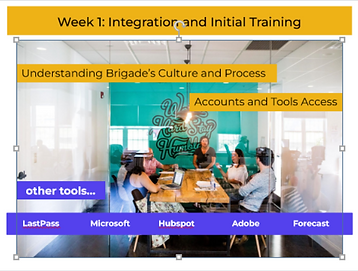
Management Plan: A clear roadmap for new employee onboarding was outlined, including segmenting activities and content delivery over the first 90 days. The plan detailed week-by-week objectives, integrating both learning modules and cultural immersion activities.


Personal and Interpersonal
Collaboration and Feedback: This project required working with subject matter experts. team members, and new employees in the design and refinement of the onboarding process showing a high level of collaboration and the ability to give and receive constructive feedback.
Positive Relationships: Strong relationships were established and cultivated amongst team members and clients to establish open lines of communication and demonstrate respect for the contributions of all.
Accommodate Individual and Cultural Differences: The onboarding content was designed to be inclusive and take into consideration diverse learning preferences, such as offering content in multiple formats (video, text, interactive) to accommodate different learning styles.


Cyber Quest
CyberQuest is a Virtual Learning Environment (VLE) that empowers learners with the
fundamentals of cybersecurity. This VLE is a self-paced, single player game that allows for
exploratory learning in a safe environment. Educational settings which
allow for experimenting encourage the development of cognitive resilience, which is necessary
for learning.

Analysis
VLEs are a natural fit in several situations. One such situation is using
games to increase student engagement and motivation. The current target audience of 10-12
years old have always had technology in their lives and they may navigate online spaces quickly.
Without careful attention, the target audience could miss small details that lead to cybercrime.
According to the FBI Internet Crime Center Report (2015-2020), crimes against children have
increased by 144%. This is equal to 8 children per day facing online exploitation. When there is
a lack of concern, introducing interactive content can attract and engage them.
The main topics include safe email practices, protecting personal information with strong
passwords, and the steps to take for safe web browsing. To learn each of these skills, learners
will travel through a mystical forest, a dragon’s cave, and a castle.

Communication
Virtual Learning Environments (VLEs) like CyberQuest require effective communication in a variety of formats such as written and visual to explain complex concepts like cybersecurity in a way that is understandable for learners.
Written Communication
Articulation of the Learning Objectives: Each learning objective is clearly articulated in written form to ensure that learners understand what they will gain from the VLE.
Instructions and Storytelling:
The VLE features written instructions and a rich narrative that guide learning.


Design
Application of Learning Theories: Integrates principles from educational theories, such as constructivism, by allowing learners to build knowledge through interactive exploration and problem-solving within the game, such as users crafting strong passwords and employing them to defeat challenges, like a dragon, encouraging active learning and the application of cybersecurity principles.
Curriculum and Program Design: Encompasses a structured curriculum designed to progressively introduce and build upon cybersecurity concepts, ensuring learners acquire foundational knowledge and skills. The game's progression from simple password creation to more complex security practices mirrors a well-thought-out curriculum that scaffolds learning.
Interactive Design Principles: Utilizes interactive elements, such as drag-and-drop exercises and scenario-based learning, to engage learners actively and facilitate the application of knowledge in simulated real-world contexts.
Alignment of Outcomes, Strategies, and Assessments: Each module within CyberQuest is designed to achieve specific learning outcomes, employing strategies that match these goals and assessments that accurately measure learners' understanding.
Application is no longer available.
Technology and Media
CyberQuest leverages Articulate Storyline to create an interactive, multimedia-rich learning experience. This expertise is demonstrated through the use of diverse features, such as custom animations and simulations to integrate assessments that adapt to learner inputs.

CyberQuest was developed using advanced skills in Articulate Storyline.
Evaluation and Research
Dynamic Feedback and Assessment: Fosters an engaging learning experience through interactive elements that not only engage learners but also serve as vital assessment tools, providing immediate feedback and collecting data on user performance. This approach has enabled CyberQuest to be iteratively responsive, ensuring it meets educational objectives while enhancing cybersecurity understanding in a compelling, interactive format.
-
Integrated comprehensive feedback and assessments within CyberQuest, demonstrating advanced evaluation and research skills.
-
Developed a module for crafting strong passwords, featuring a text entry field with rules to engage users in applying knowledge to overcome challenges, such as defeating a dragon, providing immediate formative feedback.
-
Implemented a drag-and-drop activity for learners to identify the strongest password among options, serving as an embedded assessment to test and reinforce cybersecurity principles.
-
Applied direct user feedback and assessment outcomes in an iterative design process, highlighting the ability to use evaluation and research skills for creating engaging and educational instructional materials.

Management
-
Holistic Management Approach: Combined creative ideation with practical execution skills in the creation of CyberQuest to conceive of an innovative VLE while also steering a complex, collaborative project to completion and maintaining coherence in design and functionality throughout development.
-
Project Leadership: Created the original concept and narrative for CyberQuest along with a design proposal to gather team members. Oversaw the overall look and plan for the VLE ensuring that both the visuals aesthetics and structured layout and interactions aligned with the learning outcomes and user experience goals, helping maintain focus and drive the project forward.
-
Use of Project Collaboration Tools: Project files were setup and maintained using shared documents and folders on cloud-based platforms ensuring real-time access to updates, resources, and feedback for seamless collaboration and communication amongst team members.
-
Task Delegation and Follow-up: Tasks were efficiently delegated to team members based on their strengths and capabilities optimizing individual contributions. Regular meetings were scheduled along with appropriate follow-up meetings to ensure progress, address challenges and strategize future steps.

Original project proposal
Personal and Interpersonal
The development of CyberQuest stands as a testament to the effectiveness of a well-coordinated team, with me leading as the head designer and creator. This role not only highlighted my capabilities in steering a project of this scale but also underscored the collaborative spirit and mutual support that characterized our team dynamics:
Leveraging Team Strengths: Recognizing and utilizing the unique strengths of each team member was key to our success. By assigning tasks that matched individual skills and interests, collective productivity and innovation were maximized.
Cohesive Team Dynamics: The ability to work as a cohesive unit, supporting each other through challenges and celebrating successes, fostered a positive and productive work environment. This teamwork was instrumental in overcoming obstacles and achieving the project objectives.
.png)
Fostering Empathy and Collaboration
Fostering Empathy and Collaboration using Collaborative Decision Making is an e-learning website that exemplifies a holistic application of instructional design principles, integrating technology and media effectively to foster key professional skills. It represents a significant contribution to the field of educational technology and instructional design, particularly in the areas of empathy and collaborative decision-making.
using Collaborative Decision Making

Analysis
Analyze Learning and Performance Problems: The content focuses on improving empathy and collaboration, addressing common challenges in team dynamics. By addressing the need for empathy and collaborative decision-making in professional settings, the website identifies and proposes solutions to common workplace challenges, reflecting strong analysis skills.


Communication
Clear and Concise Messages: Content is presented in an organized manner using things like tabs, lightboxes and a site map enabling the communication of a complex concept like CDM in an accessible way.
Effective Use of Messaging Principles: The use of animations and videos to explain CDM tips and principles showcases skill in producing visuals that adhere to message design principles, enhancing learner engagement. Consistency is seen throughout the website and uses audio and visuals to elicit and emotional connection in the user.
Visuals Adhere to Message Design Principles: The use of cohesive calming color schemes and clear visuals in the site's layout aids in effective message delivery.
Delivering engaging presentations: Videos integrated into the site serve as engaging presentations, potentially enhancing learner understanding of collaborative decision-making.
The use of well-designed visuals and articulate, concise written content on empathy and collaborative decision-making principles demonstrates effective communication across formats.
The structured presentation of CDM principles, employing clear language and organized tabs, ensures messages are easily understood.


Design
Interventions Address Learning and Performance: The layout provides a clear pathway for users to follow, ensuring they engage with all aspects of collaborative decision-making.
Alignment of Outcomes, Strategies, and Assessments: The site map indicates a well-thought-out structure aligning learning objectives with interactive content and assessment methods.
Design Skills
Curriculum and Instructional Design: The structured layout of the website, covering the importance of empathy, principles of CDM, and practical scenarios, indicates proficiency in designing a comprehensive curriculum focused on soft skills development.
Interaction Design Principles: Incorporating interactive elements such as clickable tabs, lightboxes for in-depth exploration, and scenario-based learning demonstrates your ability to design engaging and informative educational experiences.


Technology and Media
Appropriate Use of Technology and Media: Videos, pop-ups, and lightboxes are used effectively to convey information and facilitate learning. The integration of multimedia resources, external links to authoritative articles, and interactive quizzes highlights capability in selecting and using technology and media to achieve specific learning outcomes.
Rationale for Technology and Media Decisions: Each technological feature serves a specific purpose, such as videos for explaining concepts and quizzes for assessment.


Evaluation and Research
Formative and Summative Evaluation Plans: The website includes a quiz at the end of the module, which provides feedback based on users' responses, embodying both formative and summative evaluation strategies to measure learning effectiveness.

Management
Development of a Management Plan: The website’s structure, which includes a site map and clearly defined sections, indicates careful planning of the learning journey.
Collaboration with Team Members, Clients, and Stakeholders: The modules on "Principles of Collaborative Decision-Making" and "Examples of Collaborative Decision-Making" suggest practical applications of stakeholder collaboration.
Resource Allocation: The development of this module, from content creation to the integration of multimedia elements, required effective planning and management of both technological and informational resources.


Personal and Interpersonal
Effective Collaboration with Others: Modules such as "Fostering Empathy in Personal Relationships" and "Fostering Empathy in Professional Relationships" directly target the development of interpersonal skills.
Adherence to Legal and Ethical Standards: The content, such as the links to external authoritative sources like Forbes, show a commitment to accuracy and ethical information sharing.